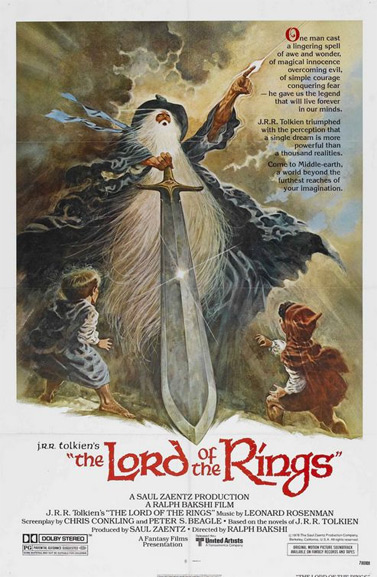
 Directed by Ralph Bakshi (1978)
Believe it or not (I’m hoping my facetiousness is apparent), I was a huge Tolkien fan when I was a kid. I’m sure I can’t remember what year it was, but the night my dad brought home our first family VCR we rushed out to the (sadly now defunct) Video World and grabbed the two tapes my brother and I would watch again and again over the next several years: the Rankin/Bass Hobbit and John Boorman’s the Emerald Forest (for years that was his favorite movie, go figure… BTW: Boorman nearly adapted LotR himself, he reused the sets he built for Excalibur).
I actually had two maps of Middle Earth hung on my bedroom wall (one was next to an image of the members of Public Enemy hanging out in a maximum security prison; pretty sophisticated juxtaposition of the kind of things boys in their pre-teens are drawn too – thanks for offering the tools needed to create such a dynamic collage, Prints Plus!).
I hoarded copies of the author’s books, which wasn’t all that easy considering that until the advent of the Book Barn years later, there really was no local spot that dealt in used books, though occasionally the Booksmith in New London would have an unusual looking pressing of Smith of Wootton Major and Farmer Giles of Ham.
And in an gesture I’m still in awe of, the first time I met my father-in-law he presented me with a hardcover copy of the edition of the Hobbit he himself illustrated (awesomely).
But of all things Tolkienian, the Bakshi movie has made the deepest impact.
I’m not going to list to list its many inaccuracies (Tolkien enthusiasts have already complied lists taking care of that), and I’m not going to compare it to Peter Jackson’s films (plenty of articles are out there for the reading); while there’s no way to deny that this movie has its flaws, it’s an amazing work of art and it’s the imagery I’m really, really into.
I’ve collected a number of stills below/after the jump giving special attention to what I think is the film’s finest sequence: Frodo’s encounter with the Black Riders just outside Rivendell; it’s here that Bakshi’s impressionistic vision is most successful. As the wounded Hobbit breaks away from his party, the background dramatically fades to an expressionistic, nightmarish landscape, partly rendered in slow motion. It’s an absolutely amazing series of shots that truly captures the terror of the Ring Wraiths and Frodo’s almost submarine decent into their world of shadow.
Click here for the rest of The Lord of the Rings
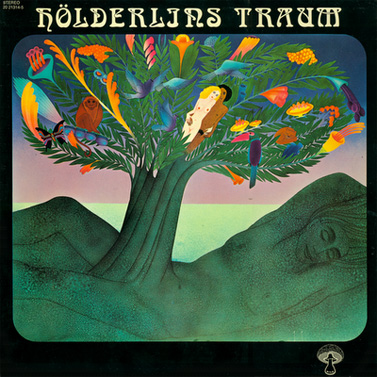 by Holderlin (1972)
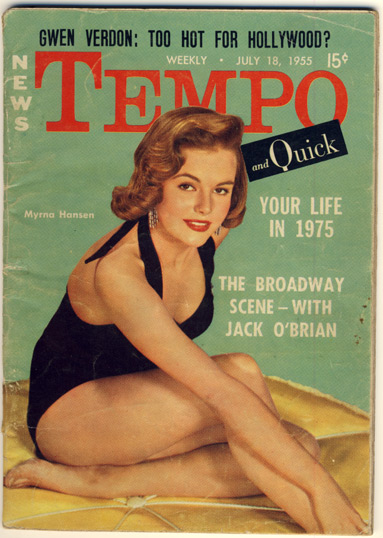 From Tempo and Quick, July 1955
 directed by Larry Cohen (1976)
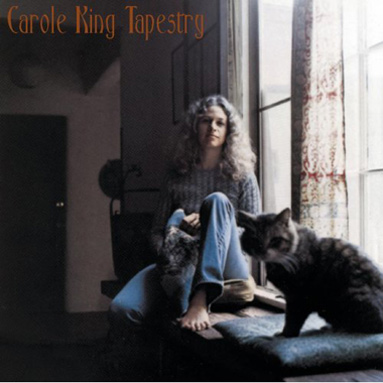 by Carole King (1971)
 Here's what I wrote back on
  We are truly the children of the '90s and when a radio hit from that by-gone era comes wafting into our midst and we can't?help but perk up and recall some sunny afternoon in junior high.
 The definitive message behind the enthralling but dreary
  If you don't know how much I adore the work of