Movies »Red Riding Trilogy

directed by Julian Jarrold, James Marsh, Anand Tucker

Film critic David Thomson brazenly proclaimed The Red Riding Trilogy (three films directed by three different filmmakers) to be “a tragic achievement that surpasses that of ‘The Godfather'”. While I can’t quite agree with Thomson’s assertion, I’m thrilled his hyperbole has sparked so much international interest in the three films (now playing at IFC theater on 6th Avenue and On Demand) and the four David Peace novels on which they are based (the first of which I recommended a few weeks back), no matter how flawed the films themselves are.

The trilogy, which chronicles a decade of brutality (though the screen adaptation is not nearly as brutal as the book), anti-hero protagonists, sickening police corruption, torture, murder, and – not one but two – serial killers stalking the north of England, is a grim one. It’s rife with cliches while strangely remaining almost surreally confounding… After watching all three films (and I strongly believe you have to watch all three to absorb the complete feel of the work), I was both intrigued – though always kept at an arm’s length – and somewhat unsatisfied.

I’m still not entirely sure how I feel about the experience which was at times rather demanding (in no small part due to to its splintered narrative, thick northern accents and relentless violence) while at the same time almost laughably trite in its chronic overuse of rote serial-killer-drama conventions. I say ‘almost’ because in the piss soaked, knuckle-beaten, nuclear power plant dotted landscape of the films, there is no room for laughter, or even a smile. The “heroes” are almost as corrupted as the villains and the only ray of decency shines from the films’ pathetic victims and few female characters played with heartbreaking humanity by the lovely Rebecca Hall (as a grief stricken mother) and Maxine Peak (as a decent detective amongst wolves).

It’s certainly not perfect and it’s anything but pretty (although there is some lyricism to the cinematography, particularly the first installment shot on 16mm) but it’s definitely worth a look. By the way, reading the books won’t entirely spoil anything – the film adaptations vary drastically at times and even omit the second book (1978) of Peace’s tetralogy completely.

Click here for the rest of Red Riding Trilogy
See more: Movies


Be the first to leave a comment →
Posted on February 14, 2010

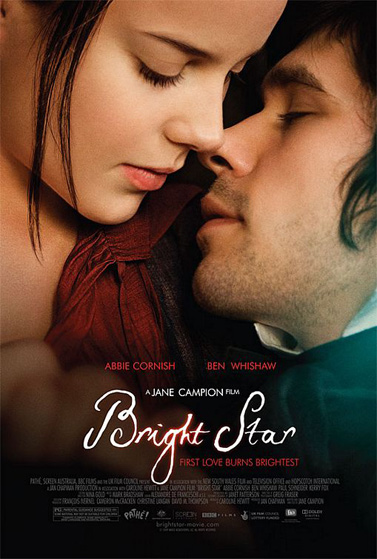
Movies »Bright Star

directed by Jane Campion (2009)

There’s a reason some people find the state of contemporary romance films dull, trite, and unwatchable, and for the most part, I’m one of those people. But in the hands of master filmmaker Jane Campion (whose best work is still the bloody skinemax-tastic In the Cut), the tired and staid genre is given fresh life with Bright Star.

Quiet energy radiates from the impressive cast: the beautifully fey and almost disturbingly rail thin Ben Whishaw as poet John Keats and the refreshingly non rail thin, spirited and (please forgive me Reese) quite pretty Abbie Cornish as the love of his life, Fanny Brawne. Filling out the cast – to my complete surprise – was Paul Schneider as fellow poet Charles Armitage Brown, whom you might recognize as Mark Brendanawicz from Parks and Recreation.

So many historical films feel like little more than tight-lipped actors in big costumes pontificating in period accents on museum sets, but there’s a lived-in, natural feel to the settings and the incredible clothing (multi buckle flats and three tiered ruffle collars, please make a come back!) of Bright Star. But don’t get me wrong, Campion’s vision of the period is characteristically stylized and visually romanticized. Crisp white curtains billow with spring breezes from every window, exquisitely serene and simple bedrooms look like paintings of dignified restraint, every garden is overgrown with the most sumptuous wildflowers.

Her signature touch elevates the sometimes slow (it’s just way too long) but sometimes heart-twitteringly romantic (couldn’t help but get flushed watching the first kiss) tale of love and heartbreak that’s been told in some way or another a million times (guess who’s going to die? The one that went out in the cold and came back with a cough!).

Click here for the rest of Bright Star

See more: Movies


Be the first to leave a comment →
Posted on February 7, 2010

Movies »Hausu

directed by Noribuki Obayashi (1977)

You might recognize Hausu from a viral video I blogged about months back. Surely, you might assume, the entire movie can’t be as insane as that clip of the killer lampshade and those images of severed limbs and demonic cats… but if that’s what you assumed, I’m happy to report that you are so, so wrong.

To describe this film as crazy, schizophrenic, bonkers, and wild is a gross understatement; it’s an excess of experiments that will blow the mind of the viewer and open the doors of perception to any artist (especially those working in film and video) to just how far the boundaries and tropes of the medium can be pushed… It’s basically the craziest thing I’ll probably ever see and my grand kids will probably hear tell of its cinematic insanity.

What happens is this: a group of school girls go to visit one of their auntie’s for vacation. Before you know it, a decapitated head jumps around and bites a girl’s butt, an old lady has an eyeball in her mouth and dances with a skeleton, another girl is eaten and dismembered by a piano, and a man turns into a pile of bananas after enjoying some ramen with a bear. What, really, can you expect from a film that lives by the logic “Old cats can open doors, but only ghost cats can close them again.” The ghost cat in this case is Snowflake, the coolest Persian ever put on screen, who is frequently flung into the arms of actors by off-screen feline throwers. The movie certainly has a sense of humor.

Director Nobuhiko Obayashi is an experimental icon whose career only just began with this masterpiece of mayhem. His other titles include If She Looks Back, It’s Love, The Girl Who Leapt Through Time, Beijing Watermelon, I Want to Hear the Wind’s Song, and only just a few years back, Before That Day. While much of his work is even harder to come by than Hausu, here is a site that features some of his early experimental work. And despite what you or anyone might think based on the description, Hausu does not quite qualify as purely experimental. It was, in fact, a huge hit in Japan upon its release.

If you’re ever able to access a copy of this movie and you want to know what it might be like to be an insane person, do not let the opportunity pass you by; we have our good friends Matthew and Nora to thank so very much for the DVD-R we now proudly own. The IFC theater on 6th Avenue played it just the other night (sorry for not giving enough warning), in the meantime, gaze upon the stills I’ve gathered below/after the jump.


Click here for the rest of Hausu

See more: Movies


One Comment →
Posted on January 31, 2010

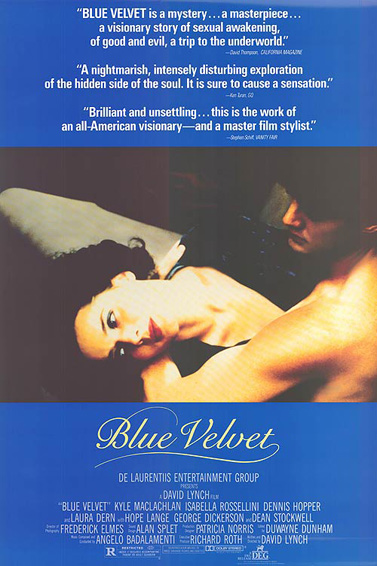
Movies »Blue Velvet

directed by David Lynch (1986)

Blue Velvet is an example of the work of an artist with a singular vision at its best. Next only to the first season of Twin Peaks, Blue Velvet is David Lynch’s tightest, most dynamic, haunting and effective work. Still, it manages to be surprisingly unseen even by people who claim to be fans of Lynch’s work. As a girl I was obsessed with the movie long before I even saw it, I’d speculate about the plot based on the poster until my parents relented and let me watch it years later in my early teens.

In this highly symbolic tale of the dark side of small town America, a remarkable cast (Isabella Rossellini, Dennis Hopper, Laura Dern, Dean Stockwell, Brad Dourif, and Jack Nance) acts out a disturbing melodrama turned on its ear (both figuratively and literally). Even with the deliberate pacing – and as those of you who have seen it can attest, everything about this film is deliberate: from the color of the hallways, the angle on the stairwells (only Lynch can create scary stairwells, see Laura Palmer’s house) to the hum and tone of the rooms – the action moves rapidly. It’s a wild ride, not unlike the joy ride a certain insane character demands.

It’s a Lynchian film through and through and unlike anything else you’ve seen, though it’s not for everyone. I can’t quite believe I’ve failed to recommend it before now, but better late than never. And if you’ve seen it before, it only gets better with each subsequent viewing.

Click here for the rest of Blue Velvet

See more: Movies


Be the first to leave a comment →
Posted on January 24, 2010

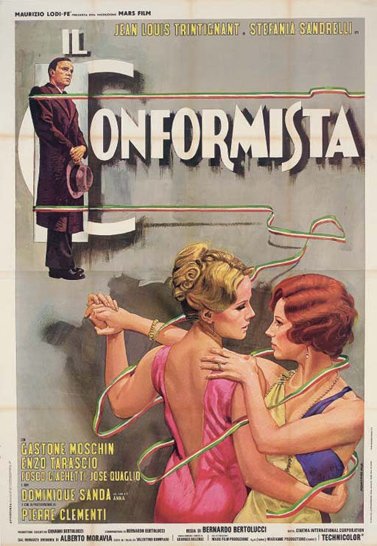
Movies »The Conformist

conformistdirected by Bernardo Bertolucci (1970)

Fans of exquisite cinematography might be familiar with Bernardo Bertolucci’s classic The Conformist, scenes of which are frequently cited in serious discussions of the craft. It truly is a gorgeous movie and every single shot is an aesthetically pleasing piece of art. Photographer Vittorio Storaro‘s work here inspired Francis Ford Coppola’s Godfather films.

The art direction and costumes, as well as the acting is all phenomenal. You might recognize Jean Louis Trintignant from the bizarre gialli, Death Laid an Egg, his love interests (Dominique Sanda and Stefania Sandrelli) are as lovely as the photography.

Of course, a movie is more than just the sum of its cinematography and leading ladies and this is one quite odd and coldly effective. I’ve never read the book by Alberto Moravia, but if it matches the tone and mood of Bertolucci’s adaptation, I’d assume it shares much with the work of Kafka and Sartre, although the specific horrors depicted here (giving up one’s identity and soul to a Fascist regime in order to fit in) are far from metaphoric; this story comes out of a very real and very recent chapter in Italian history.

Click here for the rest of The Conformist

See more: Movies


Be the first to leave a comment →
Posted on January 17, 2010

Movies »Pumping Iron

pumping_irondirected by George Butler and Robert Fiore (1976)
It’s always been hard for me to believe that Pumping Iron is a great movie, not just as a piece of bizarro kitsch, but a respected documentary that  frequently tops reasonable peoples’ lists of their favorite films… until I watched it, of course. The film, set during and before the 1975 Mr. Olympia competition in South Africa, follows the king of the sport, Aaanold as well as his upstart competition, a then sweet and dopey kid named Lou Ferrigno, his friend and fellow champion, Franco Columbo and other lesser known men striving to achieve success in the unique world of body building.

The movie shares much with some of my favorite documentaries: the well renowned The King of Kong and the criminally forgotten Derby in that it’s an intimate portrait of a small subculture that is strange to most of us; it’s always fascinating to get into the minds of people obsessed with what they love.

It’s a well made piece of vérité that’s infinitely quotable:

“It’s like I’m cumming all the time” – Arnold

“I’m the kind of person that’s like the kind of dog that’s going to bite back” – Mike Katz

“I was always dreaming about powerful people – dictators and things like that” – Arnold

“Milk is for babies. When you grow up you drink beer” – Arnold

After years of being unavailable, the DVD can now be widely purchased, so do enjoy!

Click here for the rest of Pumping Iron

See more: Movies


Be the first to leave a comment →
Posted on January 10, 2010

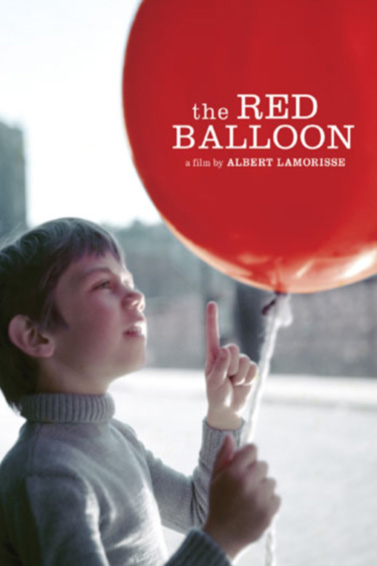
Movies »The Red Balloon

the red balloondirected by Albert Lamorisse (1956)

The Red Balloon is a beloved daydream-like classic. It plays daily at the Museum of Moving Image and was perfect Christmas weekend viewing on my laptop. The simple yet stunning little movie celebrates imagination, childhood and France and makes you joyful to have memories of any of those things. With its wordless story of a boy’s friendship with a big red balloon, a delightful score by Maurice Leroux, and beautiful images by Edmond Séchan, The Red Balloon has been charming audiences of all ages for decades.
Producer, writer director Albert Lamorisse cast his own son as the little boy who, along with the neighborhood kids (bullies included) is dressed impeccably stylishly French (rollneck grey sweaters and small school boy briefcases).

If you’ve missed this tiny masterpiece, watch it now on Netflix instant.

Click here for the rest of The Red Balloon

See more: Movies


Be the first to leave a comment →
Posted on December 26, 2009

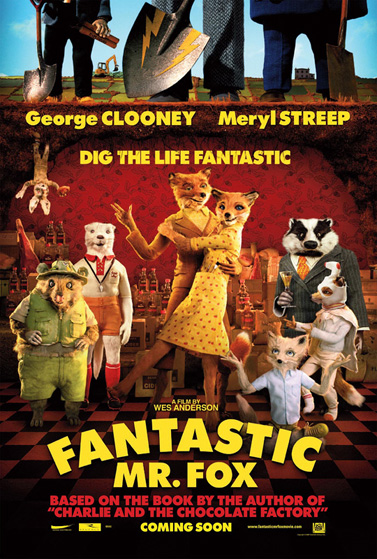
Movies »Fantastic Mr. Fox

fantastic_foxdirected by Wes Anderson (2009)

Wes Anderson’s movies have a particular hipster artistry that sometimes yields poignant and aesthetically pleasing magic (Royal Tenenbaums, Rushmore), other times it results in slightly annoying, self satisfied quirkiness (Steve Zissou, and, so I’ve heard, Darjeeling Limited). Fantastic Mr. Fox falls squarely on the magical side, not only in terms of the plot and the story (by Roald Dahl, which Anderson and screenwriter Noah Baumbach greatly expanded on for the film), but the stop motion animation is simply amazing.

The set, character, and costume design (I love Mr Fox’s cord suit and his son’s home made super hero get ups) is unerringly charming and whimsical and I hope it inspires more delicately thoughtful stop motion features in this era of crass computer animation (Pixar excluded, of course). Drastically unlike those churned out kid’s flicks, Fantastic Mr. Fox is far more stylized and perhaps  even more delightful for stylish parents than their children (wacky sing-a-longs with Jarvis Cocker, anyone?), and the tone is decidedly more subtle, sophisticated, and bittersweet than usual talking animal fare. I went with my office after an exhausting season of late nights and we all walked out like a bunch of kids with big smiles on our faces.

Click here for the rest of Fantastic Mr. Fox

See more: Movies


Be the first to leave a comment →
Posted on December 20, 2009

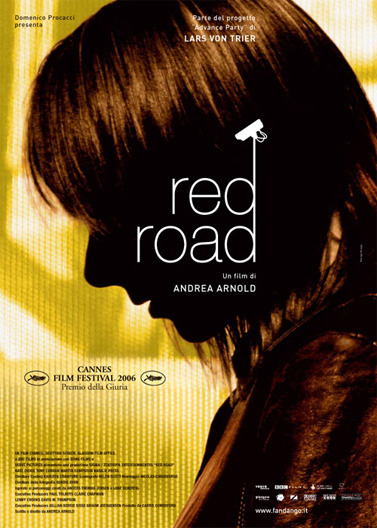
Movies »Red Road

red roaddirected by Andrea Arnold (2006)

Few films manage to sustain tension and suspense as well as Red Road, a thriller that causes the viewer to continually wonder what’s exactly is going on, manages to. Jackie is a security camera operator in a very, very bleak housing estate of Glasgow (can’t imagine the Scotland tourism board endorsing this one) who observes the people around her at a distance without their knowledge. One night, she is shaken by a face she recognizes on her screen.

Most of the film is fueled by the constant surprises. Who is this man, and what is his relationship to Jackie? Why was she so upset at the sight of him, yet he doesn’t know her face? As in any thriller built around a tower of questions, the answers are not always as fulfilling as the asking, but in this case, the reveal changes the entire tone and message of the movie. Thought you were simply going to get scared and see some vengeance? Try a totally raw sex scene (the closest I’ve seen to realistic doing it on film in some time) and redemption. I have to admit, it initially turned me a bit off until I accepted that it was a different film than I expected.

But to say Red Road is merely a sum of its plot elements is unfair. Through the dogme techniques, director Andrea Arnold paints a very tactile and realistic world. She manages to make not only sex, but parties, breakdowns, bars, and fights feel like you’ve just stumbled into them. Quite a feat for a directorial debut.

The movie is available on netflix instant, a great way to discover films you might otherwise never hear about.

Click here for the rest of Red Road

See more: Movies


Be the first to leave a comment →
Posted on December 13, 2009

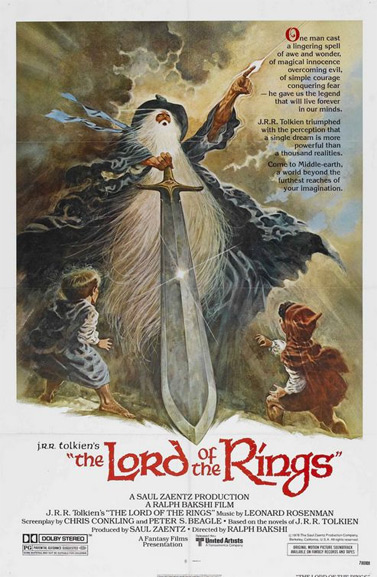
Movies »The Lord of the Rings

Ralph Bakshi's Lord of the RingsDirected by Ralph Bakshi (1978)

Believe it or not (I’m hoping my facetiousness is apparent), I was a huge Tolkien fan when I was a kid. I’m sure I can’t remember what year it was, but the night my dad brought home our first family VCR we rushed out to the (sadly now defunct) Video World and grabbed the two tapes my brother and I would watch again and again over the next several years: the Rankin/Bass Hobbit and John Boorman’s the Emerald Forest (for years that was his favorite movie, go figure… BTW: Boorman nearly adapted LotR himself, he reused the sets he built for Excalibur).

I actually had two maps of Middle Earth hung on my bedroom wall (one was next to an image of the members of Public Enemy hanging out in a maximum security prison; pretty sophisticated juxtaposition of the kind of things boys in their pre-teens are drawn too – thanks for offering the tools needed to create such a dynamic collage, Prints Plus!).

I hoarded copies of the author’s books, which wasn’t all that easy considering that until the advent of the Book Barn years later, there really was no local spot that dealt in used books, though occasionally the Booksmith in New London would have an unusual looking pressing of Smith of Wootton Major and Farmer Giles of Ham.

And in an gesture I’m still in awe of, the first time I met my father-in-law he presented me with a hardcover copy of the edition of the Hobbit he himself illustrated (awesomely).

But of all things Tolkienian, the Bakshi movie has made the deepest impact.

I’m not going to list to list its many inaccuracies (Tolkien enthusiasts have already complied lists taking care of that), and I’m not going to compare it to Peter Jackson’s films (plenty of articles are out there for the reading); while there’s no way to deny that this movie has its flaws, it’s an amazing work of art and it’s the imagery I’m really, really into.

I’ve collected a number of stills below/after the jump giving special attention to what I think is the film’s finest sequence: Frodo’s encounter with the Black Riders just outside Rivendell; it’s here that Bakshi’s impressionistic vision is most successful. As the wounded Hobbit breaks away from his party, the background dramatically fades to an expressionistic, nightmarish landscape, partly rendered in slow motion. It’s an absolutely amazing series of shots that truly captures the terror of the Ring Wraiths and Frodo’s almost submarine decent into their world of shadow.

Click here for the rest of The Lord of the Rings

See more: Movies


Be the first to leave a comment →
Posted on December 6, 2009